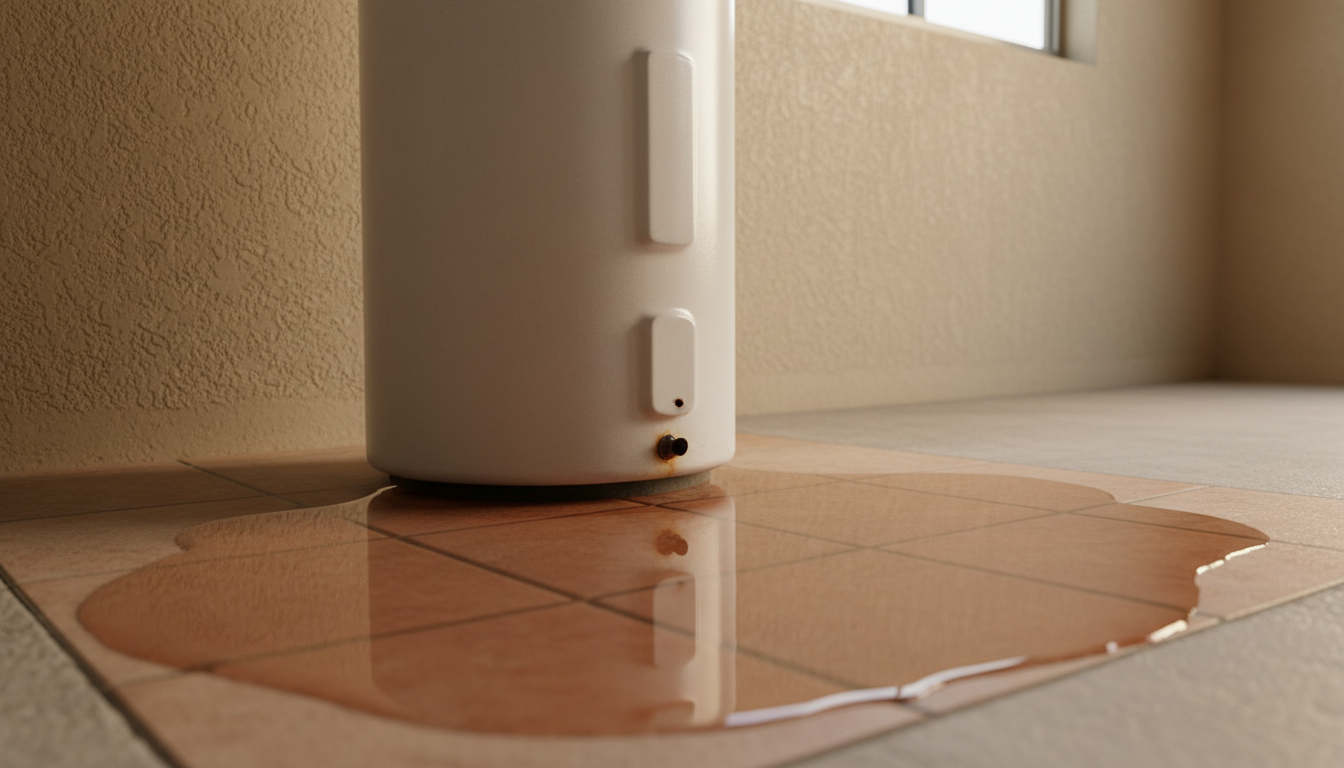
You walked into the garage and your shoes squelched. Or you opened the closet and saw a dark halo spreading across the tile. A puddle around the water heater is one of those moments where every minute matters, and most Sarasota homeowners lose the first hour to panic and Google.
Two facts national blogs miss. First, mold germinates within 24 hours in Sarasota’s heat and humidity — not the 24 to 72 hours you’ll read elsewhere. Second, a water heater leak is two separate problems: stopping the leak (a plumber’s job) and drying the structure (a restoration contractor’s job). Calling only the plumber is the single most expensive mistake Sarasota homeowners make, because the plumber swaps the unit and leaves while moisture wicks into the subfloor, baseboards, and wall cavities.
Seven steps, in order, for Sarasota specifically.
Step 1: Power and Water Shut-Off — Do This Before Anything Else
Cut the power first, then the water. Reversing that order is how people get hurt. A live electric heating element in a draining tank can dry-fire and start a fire. A live unit sitting in standing water is a shock hazard you don’t want to test.
For an electric heater, find the 30-amp double-pole breaker at your main panel. In most Sarasota homes the panel sits in the garage within ten feet of the heater, and the breaker is usually labeled “WH” or “Water Heater.” Flip it OFF. For a gas heater, turn the gas control valve near the bottom of the unit to OFF or PILOT. Do not attempt to relight the pilot — a plumber needs to evaluate the unit first.
Now shut off the cold water inlet. That’s the pipe on the cold-water side above the tank, and the valve turns clockwise to close. Sarasota’s hard water leaves calcium deposits that can seize these valves solid after a few years. Do not force it. If the valve won’t budge, go straight to the main shutoff at the meter or the exterior wall of the garage.
If you cannot find the breaker and cannot stop the water, call a plumber right now from where you’re standing. Do not keep troubleshooting while water spreads.
Warning: On electric units, cut power at the breaker before you touch anything. A live element in a drained tank is a fire risk. A live unit in standing water is a shock hazard.
Tip: Once the crisis is over, label the water heater breaker with a Sharpie so the next person in your household finds it in ten seconds.
Step 2: Insurance Documentation — Photograph Everything Before You Touch Anything
Your phone camera is your most valuable tool in the next five minutes. Florida HO-3 policies cover “sudden and accidental” appliance failure but exclude gradual damage. If your photos later show mineral staining, rust streaks, or old corrosion, the adjuster has grounds to call this gradual and deny the claim.
Shoot in this order so your evidence tells a clean story:
- Wide shot of the heater and the full water footprint on the floor
- The model and serial number plate on the side of the unit
- Close-up of the visible leak point
- The water footprint as it has spread
- Damage to baseboards, drywall, cabinets, and adjacent rooms
- A shot that clearly shows the camera’s timestamp, which documents “sudden”
Florida Statute 627.70131 gives your insurer 14 days to acknowledge the claim and 90 days to pay or deny. Strong photo documentation inside the first hour is what keeps that clock honest.
Do not throw away the old heater until the adjuster has seen it. The failed tank is physical evidence of sudden failure, and a photo of a dumpster is not as persuasive as a rusted-through tank sitting in the garage.
Tip: Record a slow 360-degree video around the heater. Narrate what you see and say the date out loud. A 45-second clip with a timestamp beats 20 still photos in a dispute.
Step 3: Leak Source Diagnosis — Top, Bottom, Side, or Condensation?
Where the water comes from tells you whether this is a repair or a replacement. Water heaters leak from four places, and the location is diagnostic.
Top of the tank. Almost certainly a cold or hot water inlet fitting, the T&P (temperature and pressure relief) valve, or the anode rod port. Usually repairable and relatively inexpensive.
Bottom of the tank. Either a failed drain valve (fixable) or a corroded tank wall (not). If water is spreading from no single point at the base, the tank has rusted through from the inside. Replacement is the only option.
Side of the tank. Usually the T&P valve discharge pipe, which means a pressure or temperature spike inside the tank or a faulty valve. A plumber needs to evaluate before you run the unit again.
Condensation. Not a leak. New heaters in humid Sarasota garages sweat during their first week of operation because the cold inlet pipe and tank surface drop below the dew point. Sarasota garages run 75 to 85 percent relative humidity year-round.
To find the source, dry everything around the base with towels, then watch for fifteen to thirty minutes. Where water reappears first is your leak point.
Now the Sarasota-specific hard truth. Local hard water strips the anode rod faster than the national average, and once the anode is gone the tank corrodes from the inside out. Sarasota water heaters commonly fail at 7 to 9 years, not the 12-year manufacturer rating. A seven-plus-year-old tank leaking from the bottom is almost always corrosion. Budget for replacement — roughly $2,000 for a standard tank installed or $3,000 to $5,000 for tankless.
Decision Rule: Tank 7+ years old AND leaking from the bottom = replace, don’t repair. Sarasota hard water accelerates the failure curve, and the plumber will tell you the same thing.
Step 4: Hidden Damage Check — Look Under the Floor and Behind the Walls
The water you can see is roughly 20 percent of the damage. The rest is already wicking into baseboards, spreading under tile through grout, soaking drywall above the floor line, and saturating cabinet kick plates. This is the section most homeowners skip, and it turns a $2,500 job into a $15,000 one.
The IICRC S500 standard (the industry rulebook for water damage restoration) requires Category 1 clean water to be extracted within 24 to 48 hours. After 48 hours, wet porous materials must be removed, not dried in place. In Sarasota, mold germinates at the 24-hour mark and visible colonies appear at 48 to 72 hours — the fastest clock in the country outside coastal Louisiana.
A 10-minute walkthrough you can do right now:
- Tile floor. Tile dominates Sarasota homes, and it lies. The surface dries in minutes, but water travels through grout lines to the underlayment. Press a dry paper towel firmly into grout lines within a six-foot radius of the heater. If it comes up damp, water is under the tile.
- Drywall. Press the back of your hand against the wall at 6 inches and 12 inches above the floor. If it feels cold, soft, or yielding, water has wicked up. Drywall pulls moisture 12 to 24 inches above the visible waterline.
- Baseboards. Look for a darkened horizontal line or any spot where the baseboard pulls away from the wall. That’s wood swelling from absorbed water.
- Cabinet kick plates. Pop off the toe-kick panel under any adjacent cabinets. The subfloor under there holds water longer than anywhere else in the room.
- Carpet. Lift a corner near the heater and squeeze the pad underneath. Carpet face dries fast. The pad holds water for days.
What you cannot see without equipment: moisture inside wall cavities, under vinyl plank or laminate flooring, and inside insulation. That requires a moisture meter and a thermal imaging camera — standard gear for any IICRC (Institute of Inspection, Cleaning and Restoration Certification) certified restoration contractor.
IICRC also requires wood framing to dry below 16 percent moisture content before new drywall goes up. Skip that step and you grow mold behind the new wall, discovered six months later when somebody gets a headache that won’t go away.
Red Flag: If you smell anything musty or earthy, like a locker room, stop testing surfaces. Mold has already started. Call a restoration contractor now.
Honest threshold: if the water sat on the floor more than 4 hours, spread more than 10 feet, or touched carpet or drywall, towels and a box fan cannot handle this.
Step 5: Make Both Calls — Plumber AND Water Damage Restoration Contractor
This is the step that separates a contained incident from a renovation project. Both calls happen today — not sequentially, not after the plumber’s visit. Today.
The plumber stops the source, drains the tank, installs a replacement, and tests the new unit. Two to four hours of work. Done.
The restoration contractor handles everything the plumber doesn’t: moisture mapping with meters and thermal imaging, water extraction with truck-mounted equipment, commercial air movers and dehumidifiers, structural drying down to 16 percent MC on framing, antimicrobial treatment, and detailed documentation for your insurance claim.
Why both calls happen today: a plumber’s clock is measured in gallons per minute; a restoration clock is measured in hours until mold. In Sarasota humidity, mold starts at hour 24. A plumber arriving at hour 6 and a restoration crew arriving at hour 36 means you’re paying for mold remediation, not moisture prevention.
What to say when you call the restoration contractor: “Water heater failed. Water on [tile/carpet/drywall] in [garage/closet/utility room]. Spread to [size] area. I’ve shut the water off. How soon can a crew get here?” A legitimate Sarasota-area contractor should commit to an on-site inspection within 2 to 4 hours for an active water event.
Myth Bust: “The plumber replaced the tank, so I’m fine.” The plumber doesn’t check your subfloor. Nobody does unless you call them.
Cost context so you can match response to scope:
| Scenario | Restoration Cost | Covered by HO-3? |
|---|---|---|
| Minor (caught within hours, contained to garage floor) | $1,200–$2,500 | Yes, if sudden |
| Moderate (adjacent rooms, drywall and baseboards affected) | $3,000–$7,500 | Yes, if sudden |
| Severe (subfloor replacement, mold remediation required) | $8,000–$30,000+ | Partially (mold sub-limits apply) |
The water heater replacement itself ($2,000 to $5,000) is NOT covered by a standard HO-3 policy. That’s on you. The damage the heater caused to your home is what’s covered.
Many Sarasota restoration contractors bill the insurance company directly, which means you pay your deductible and they handle the paperwork. Ask about direct billing on the first phone call.
 Commercial-grade air movers and dehumidifiers dry a structure in 3 to 5 days — equipment that household fans cannot replicate.
Need help with a water heater leak in Sarasota? Describe the problem using the contact form on this site and we’ll try to connect you with a licensed Sarasota-area restoration contractor. We can’t guarantee a match.
Step 6: Insurance Claim Filing — Use Florida’s Timelines to Your Advantage
Open the claim the same day, not next week. A “sudden and accidental” narrative holds together better when the timeline is clean and the documentation is fresh.
Florida Statute 627.70131 gives your carrier 14 days to acknowledge the claim and 90 days to pay or deny. That clock starts when you make the call, so calling today shortens every deadline that follows.
What to say to the adjuster on the first call: “My water heater failed [time/date]. I shut off power and water, documented the scene with photos and video, and I have a plumber replacing the unit and a restoration contractor drying the structure. I’d like to open a claim.”
What NOT to say: “It’s been leaking for a while.” Never suggest the heater was old, never speculate about neglected maintenance, and never use words like “slowly” or “gradually.” Stick to the moment of discovery and the actions you took.
Covered vs. not covered under a standard Florida HO-3:
- Covered: water damage to floors, walls, cabinets, flooring, contents, and the cost of restoration drying
- Not covered: the water heater itself, pre-existing corrosion, gradual leak damage, and mold beyond your policy’s sub-limit (commonly around $10,000)
Two documents close claims fastest: the plumber’s invoice showing the failed unit and the specific failure mode, and the restoration contractor’s moisture map and drying log.
Script: Read the adjuster line above verbatim on the first call. The opening 30 seconds frames how the entire claim gets adjudicated.
Step 7: Prevent the Next Leak — Sarasota Hard Water and Snowbird Checklist
The next failure is preventable if you treat hard water as the main enemy. Sarasota water strips anode rods in 3 to 5 years versus 7 years nationally. That’s why our heaters die early.
Flush the tank once a year to clear calcium sediment. Have a plumber inspect the anode rod every three years and replace it at around 50 percent wear. A $40 rod can add four years to the life of the tank — the best ROI in homeownership.
Install a leak detector. Battery-powered sensors sit under the tank, cost about $15, and chirp the moment they feel water. WiFi versions ($40 to $80) notify your phone, which is the single best upgrade for snowbirds. An auto-shutoff valve ($200 to $400 installed) closes the main water line when it detects a leak — the right move if you leave the home empty for months.
Snowbird Shut-Off Drill:
- Shut off the main water supply valve at the meter or garage wall
- Drain the heater partially after cutting power, or set the thermostat to Vacation mode
- Leave the AC running at 78°F with dehumidification active — do not turn off the AC to save money
- Ambient humidity above 60 percent for 72 hours grows mold whether or not you have a leak
- Give a trusted neighbor or property manager a key and an emergency contact number
- Pair a WiFi leak detector to your phone before you leave
Checklist: Snowbird pre-departure — main water off, heater to Vacation, AC at 78°F with dehumidify on, leak detector paired to phone, neighbor has the key.
Frequently Asked Questions About Water Heater Leaks and Water Damage in Sarasota
How fast does mold grow after a water heater leak in Sarasota?
Mold germinates within 24 hours in Sarasota’s climate versus 24 to 72 hours nationally. Visible colonies appear at 48 to 72 hours. Any porous material wet for 48+ hours should be removed, not dried in place. The EPA recommends indoor relative humidity below 60 percent to prevent mold.
How much does water damage restoration cost after a water heater leak in Florida?
Minor damage runs $1,200 to $2,500. Moderate damage with affected drywall and baseboards runs $3,000 to $7,500. Severe damage with subfloor replacement or structural issues runs $8,000 to $30,000+. Most Florida HO-3 policies cover restoration costs for sudden failures, minus your deductible. The water heater itself is not covered.
Does homeowners insurance cover water heater leaks in Florida?
The water damage to your home is typically covered if the failure was sudden and accidental. The heater itself is not. Gradual leaks, visible long-term corrosion, and deferred maintenance are grounds for denial. Document everything inside the first hour (see Step 2) and open the claim the same day.
Do I need both a plumber and a restoration company?
Yes. A plumber stops the source and replaces the unit. A restoration contractor handles moisture detection, extraction, structural drying, and insurance documentation. Two different jobs, two licensed professionals, and in Sarasota humidity they have to happen simultaneously to prevent mold.
My water heater is 9 years old — is it worth repairing?
In Sarasota, probably not. Local hard water causes heaters to fail at 7 to 9 years. If the leak is from a fitting or valve at the top of the unit, a repair may buy time. If the leak is from the tank itself — bottom moisture, rust-colored water from hot taps — replacement is the only option.
I’m a snowbird and returned to find my water heater leaked while I was away. What now?
Call a restoration contractor first for an emergency moisture and mold assessment. Scope the damage before scheduling any repairs or cleanup. Document everything as you find it. Your insurance claim may face extra scrutiny since the failure date cannot be proven as sudden, so the photo and video record matters more.
My tile floor looks dry. Do I really need to call a restoration company?
Yes. Tile dries quickly on the surface, but water penetrates through grout lines to the underlayment and subfloor. Without thermal imaging and moisture meters, hidden moisture causes subfloor decay and mold within 48 to 72 hours. “Looks dry” is not the same as IICRC-standard dry.
Dealing with a water heater leak in your Sarasota home? Describe the problem using the contact form on this site and we’ll try to connect you with a licensed Sarasota-area restoration contractor. We can’t guarantee a match.
Dealing with water damage in Sarasota?
Describe what happened and we'll try to connect you with a licensed Sarasota-area restoration contractor. We can't guarantee a match. Free to submit, no obligation.
Send Us Your Details