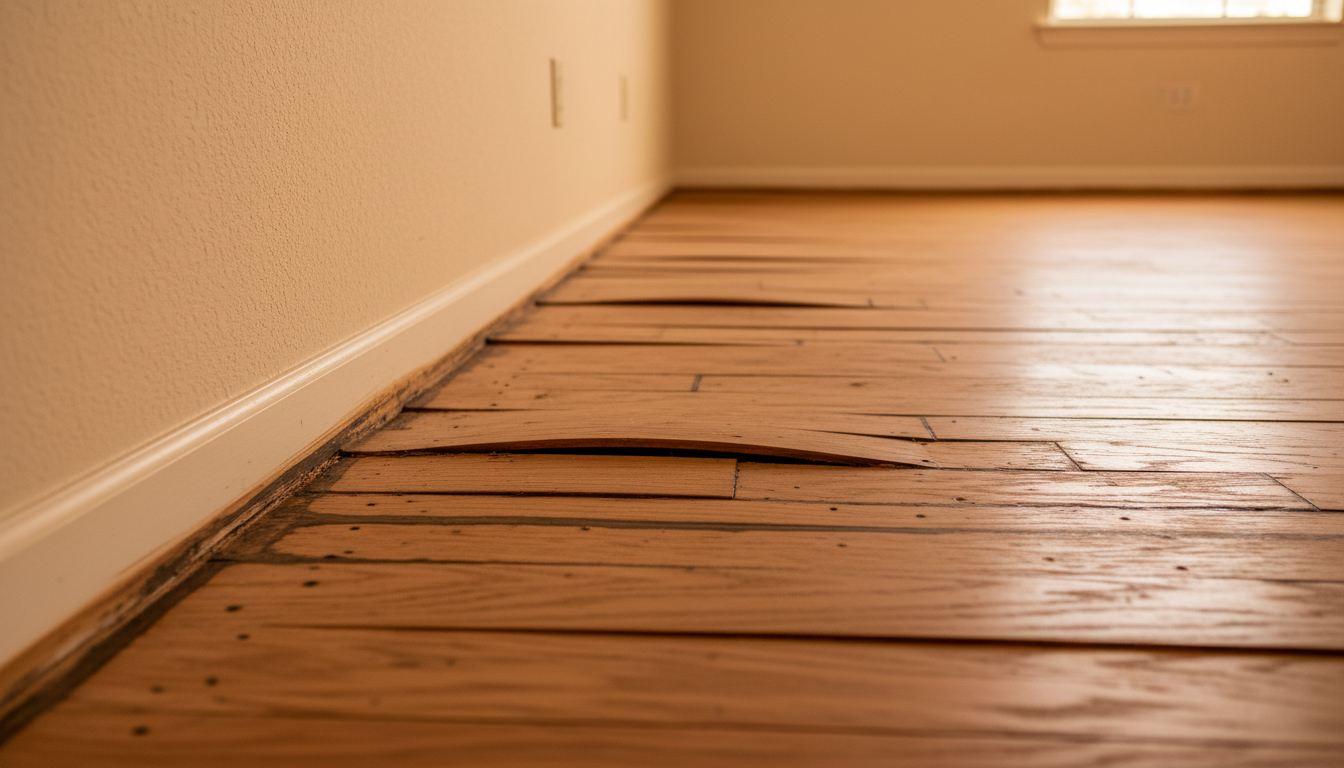
You walked into the room and felt the squish before you saw it. A buckled board near the baseboard. A dark line creeping along the seams. Maybe a storm rolled through last night, or maybe the dishwasher supply line finally let go. You are standing in a room that was fine yesterday and is now a problem.
Most guides about water damage to wood floor were written for Ohio or Texas. Sarasota is a different animal. With ambient humidity running 65 to 90 percent year-round, the IICRC’s 24 to 48 hour mold window compresses to 12 to 24 hours. That changes what “act fast” means, and it changes the math on what can be saved.
This guide walks through the 8-step sequence licensed restoration contractors follow on a Sarasota job. What to do in the first 15 minutes. How to tell a floor that can be dried in place from one past saving. Why consumer fans and dehumidifiers often make things worse in Florida. How Florida Statute 627.70131 shapes your insurance claim timeline, and why the March 2024 FEMA map update matters when the water came from outside.
Warning: Florida humidity compresses the mold clock. The national “24 to 48 hour” guidelines on non-Florida sites do not apply in Sarasota. Think 12 to 24 hours from first wet to first spore.
Step 1: Stop the Water and Protect Yourself — First 15 Minutes
Before you take a single photo or move one stick of furniture, cut the source. Everything downstream of Step 1 assumes the water has stopped. Drying a floor while the supply line still leaks wastes time, and standing in water near a live outlet is how people get hurt.
Work the shutoff in order. For a supply-line leak under a sink, toilet, or appliance, close the local angle-stop valve on the wall. If that valve sticks or is missing, shut the main at the meter. Refrigerators, washers, and dishwashers each have dedicated shutoffs. If the water came from a storm, surge, or rising groundwater, there is no valve — go straight to safety.
Next, kill power to the room at the breaker before plugging in anything or reaching for a floor-level outlet. Wet wood turns slick within minutes, so move people and pets out and put on shoes with grip. Discolored, cloudy, or foul-smelling water is almost certainly Category 2 or 3 — wear gloves and PPE, or stay out.
The Step 1 milestone: the water source is stopped, power to the room is off, and no one stands in the water.
Warning: Do not touch outlets, switches, or plug in drying equipment while standing in water. Kill the breaker first, confirm with a non-contact voltage tester if you have one, then proceed.
Step 2: Document Everything Before You Move Anything — Protect Your Insurance Claim
The single most expensive mistake Sarasota homeowners make is cleaning up before the adjuster sees the scene. Ripping out warped boards, tossing the wet rug, cutting baseboards — all of it feels productive, and all of it can wreck a five-figure claim. Florida insurers deny claims for “gradual damage” more than any other reason, and eliminating the evidence hands them that argument.
Start with photos and video, timestamps turned on in your phone’s camera settings. Shoot wide first — the whole room, every angle. Then medium shots of the affected area. Then close-ups of cupped boards, the water line on the baseboard, the leak source, and any staining. Narrate a short video as you walk through: what you found, when, where the water came from. Adjusters watch that video before reading anything.
Do not discard damaged materials. Leave the wet rug, warped transition strip, and failed supply-line hose in place, or bag and label them if they must move. Denied claims are routinely recovered because the homeowner kept the failed part.
Call your insurer within 24 hours of discovery to open the claim and get a claim number on record. Under Florida Statute 627.70131, the insurer must acknowledge within 14 days and pay or deny within 90 days. The clock starts when you file, so filing the same day matters.
Tip: Turn on location and timestamp in your phone’s camera before shooting. Record a short video narrating what you see as you walk the room — it is the strongest single piece of evidence any Florida adjuster will review.
Step 3: Identify the Water Category — Clean, Gray, or Black
The water category determines whether your floor can be dried in place or has to come out. The homeowner does not make this call on vibe. The IICRC S500 standard defines three categories, and the category dictates the entire restoration plan.
Category 1 is clean water: a supply-line break, ice maker line, refrigerator line, overflowing tub with clean water, or rainwater through a window. In-place drying is permitted if caught within 24 hours and the subfloor is dry.
Category 2 is gray water: dishwasher or washing machine discharge, aquarium water, shower wastewater, toilet bowl water without solids. Antimicrobial treatment is required, and some porous materials must be removed even when the structure is salvageable.
Category 3 is black water: sewage backup, storm surge, rising groundwater, or any water that has sat long enough for bacterial colonies to grow. Under IICRC S500, every porous material in the affected area has to come out — hardwood, engineered wood, subflooring, carpet pad, soaked drywall. No in-place drying, no exceptions. Trying to dry Category 3 water in place is how homeowners end up with mold contamination six months later.
The Sarasota-specific twist is category drift. Category 1 water degrades to Category 2 within 24 to 72 hours if untreated, and Florida’s humidity runs it at the fast end. A clean supply-line leak discovered on day three is no longer clean water.
Hurricane water, tropical storm water, flooding from a failed sump pump, and sewer backup during heavy rain are all Category 3. Full stop. The March 2024 FEMA map update moved roughly 6,000 additional Sarasota homes into high-risk flood zones, so more properties are now realistic candidates for this scenario than a year ago.
The Step 3 milestone: answer “what category is my water event” in one sentence.
Warning: Storm surge is always Category 3. If water entered your home from outside during a hurricane or tropical storm, the hardwood has to come out. No drying protocol saves it, and any contractor who suggests otherwise is either cutting corners or guessing.
Step 4: Read the Warning Signs — Cupping, Crowning, Staining, and Soft Spots
Walk the room slowly and name what you are looking at. Vocabulary matters because you will use it with adjusters and contractors. “The boards are weird” will not get you paid. “The boards in the northeast corner are cupped with an approximate 2mm rise at the edges” will.
The signs, from mildest to most severe:
Dark edges or staining along board seams. The earliest sign. Water sits between boards or has wicked into the finish. Often reversible if caught in the first 24 hours, especially in Category 1 events.
 Dark discoloration along board seams is often the first visible sign of water damage — and a signal that moisture has already moved below the surface finish.
Cupping — concave boards. Edges curl up, center stays low. Cupping happens when the bottom of the board holds more moisture than the top, which almost always means water is under the flooring or in the subfloor.
Crowning — convex boards. Center rises, edges sit low. Crowning almost always results from sanding a cupped floor too early, before moisture equalized between hardwood and subfloor. IICRC standards require under 1 percent moisture content variation between the two before any sanding.
Buckling or lifting. Boards pull free from the subfloor. The adhesive or fastener bond has failed. Buckled boards nearly always need replacement.
Soft or spongy feel underfoot. A subfloor symptom, not a hardwood symptom. Step 6 covers it in detail. If you feel flex, the problem is below the boards.
Visible mold. Black, green, or white fuzzy growth along baseboards, in closets, or between boards. In Sarasota, mold starts in 12 to 24 hours. If you see it, you are past the in-place drying window for that section.
With a pinless moisture meter, the IICRC target for hardwood restoration is under 17 percent moisture content, and the subfloor should sit within 1 percent of the hardwood before anyone discusses sanding or refinishing.
Tip: Cupping means edges up, so the bottom is wet. Crowning means center up, usually sanded too soon. Memory aid: a cupped board could hold water in the middle — the wet side is the bottom.
Step 5: Know When to Stop DIY — Why Consumer Fans Often Make It Worse
In Florida, consumer drying equipment cannot do the job, and it creates a false sense of security while mold incubates underneath. This is the most counterintuitive part of water damage response in Sarasota, and where most DIY efforts quietly fail.
Drying wood means pulling moisture out of the wood into the air, then pulling that moisture out of the air and out of the house. Both halves matter. The second half is where Florida breaks consumer gear.
Ambient relative humidity in the room must drop below 45 to 50 percent and stay there for days. Sarasota’s outdoor RH runs 65 to 90 percent nearly year-round. Your house envelope exchanges air with that load constantly — through the attic, around windows, through HVAC. Consumer dehumidifiers cannot keep pace. Professional Low Grain Refrigerant (LGR) dehumidifiers can, because they pull moisture from air that cycles a consumer unit on and off forever without winning.
The second half is air movement. Box fans and pedestal fans move air, but not at the velocity or directed angle needed to pull moisture from hardwood grain. Professional air movers run 2,800 to 3,200 CFM at specific angles across the floor, lifting moisture from the wood surface into now-dry air where the LGR grabs it.
Consumer equipment dries only the top surface. The homeowner sees standing water evaporate, touches the surface, declares victory. Meanwhile the subfloor and the underside of the boards stay above 20 percent MC, incubating spores that emerge weeks later as a musty smell with no visible source.
The realistic timeline: professional drying with LGR and air movers runs 7 to 14 days for a Category 1 event caught quickly, 3 to 5 weeks with a saturated subfloor. DIY with consumer gear in Florida humidity often never hits the IICRC target at all.
 Professional LGR dehumidifiers and high-velocity air movers must run 7 to 14 days to dry hardwood floors to IICRC standards — equipment that consumer units cannot replicate.
DIY is reasonable when the event is small — a Category 1 spill under a few square feet, caught within an hour, and you have a moisture meter reading under 17 percent MC for a week straight. Stop DIY when the affected area exceeds 20 square feet, when more than 24 hours have elapsed, when any cupping is visible, or when you have any doubt about the water category.
Not sure which side of the line you are on? Describe the problem using the contact form on this site and we’ll try to connect you with a licensed Sarasota-area restoration contractor. We can’t guarantee a match.
Warning: A floor that feels dry on top can still be 25 percent or higher moisture content underneath. You cannot tell by touch. Without a moisture meter reading, you are guessing.
Step 6: Inspect the Subfloor — The Damage You Can’t See From Above
The subfloor is where the restoration decision actually gets made. The hardwood is what you see, but the OSB or plywood underneath determines whether your floor can be saved, partially replaced, or fully rebuilt. A beautiful top-surface drying job on a saturated subfloor is cosmetic work over a time bomb.
Hardwood sits on OSB or plywood. When water runs off the hardwood, along seams, or through baseboards, it pools on the subfloor. Both materials absorb moisture readily, but OSB absorbs faster and recovers worse. Because the hardwood is nailed or glued down, moisture held in the subfloor migrates back up into the underside of the hardwood for weeks after the top surface looks dry.
Signs the subfloor is wet:
- Spongy or soft feel when walking the room
- Visible sagging between floor joists
- Staining on the ceiling of the room below (for second-floor events)
- OSB delamination — edges puff, wood chips separate
- Plywood warping or bubbling
- Musty smell with no visible mold (the mold is under the floor)
- Moisture meter readings above 15 percent in the subfloor
A proper restoration scope from a licensed contractor always includes subfloor moisture readings at multiple points. If the contractor never pulled a baseboard, never checked through a floor register, and never took a subfloor reading, they have not actually assessed your subfloor — they assessed what they could see from standing height.
The hard truth about OSB: if it is saturated, it usually has to come out. OSB does not recover from deep moisture the way plywood sometimes does. The adhesives holding the wood chips together fail when wet and do not re-bond when they dry.
Subfloor moisture content must sit under 15 percent before new flooring goes down. Installing hardwood over a wet subfloor guarantees cupping, crowning, and claim denial within 6 to 18 months.
Tip: Pop a floor register out of an HVAC vent and shine a flashlight down. You can often see the subfloor condition at the duct cutout without any demo work. If the subfloor visible at the register is stained, soft, or puffy, assume the rest is similar.
Step 7: Decide — Restore, Replace, or Full Rebuild
Four paths forward, each with a cost range and a specific scenario where it is the right call. Once the category is identified, symptoms cataloged, and subfloor inspected, pick the path that fits the facts. Florida-area benchmarks sit in the middle of these numbers.
| Path | Cost (per sq ft) | When it applies |
|---|---|---|
| Mitigation only | $3 – $7.50 | Caught early, Category 1, no cupping, subfloor dry |
| Hardwood restoration | $10 – $15 | Cat 1 or 2, some cupping, subfloor recoverable |
| Replacement | $6 – $12 | Hardwood past saving, subfloor intact |
| Full rebuild | $20 – $37 | Category 3, saturated OSB, or failed restoration |
Mitigation only means drying, dehumidification, and antimicrobial treatment. No repair work. Right call when you caught the leak in the first 12 hours, the water was clean, the hardwood is not cupped, and the subfloor reads under 15 percent MC.
Hardwood restoration adds sanding, refinishing, and spot board replacement. It fits Category 1 or 2 damage where boards cupped but moisture equalized back into spec and the subfloor is recoverable. Count on 3 to 5 weeks of drying before any sanding begins.
Replacement — pulling the hardwood and laying new over the existing subfloor — often beats aggressive restoration on older floors. If your hardwood is 20-plus years old and already worn, ask the contractor to price both paths. The answer surprises people.
Full rebuild is the path for Category 3 damage, saturated OSB, or any situation where the subfloor has to come out. Hardwood removed, subfloor removed, joists inspected and dried, new subfloor installed, new hardwood installed and refinished. Storm surge and sewage events are full rebuilds by default under IICRC S500.
The Tampa-Sarasota average water damage restoration claim runs around $4,606, but that mixes small mitigation jobs with five-figure rebuilds. Your number depends entirely on your path.
Decision logic in one pass: caught under 12 hours, Category 1, no cupping, dry subfloor → mitigation only. Caught under 48 hours, Category 1 or 2, some cupping, dry subfloor → restoration. Cupping with wet subfloor, or Category 3 → replacement or rebuild. Storm surge or sewage → full rebuild, no exceptions.
Tip: Restoration often costs more than replacement on older floors. If your hardwood is two decades old and worn, price both paths. Some homeowners save $4,000 to $7,000 on the comparison alone.
Step 8: Navigate the Florida Insurance Claim — Avoid the Traps That Get Claims Denied
Sarasota homeowners routinely lose five-figure payouts because they misunderstood which policy covers what. The Florida claim process has specific legal protections and specific traps, and the largest trap is the difference between a homeowners policy and a flood policy.
Standard HO-3 and HO-5 homeowners policies cover water that originates inside your home — a burst supply line, failed dishwasher, or roof leak from wind damage during a storm. They do not cover water entering from outside at ground level. Storm surge, rising groundwater, and most hurricane flooding are excluded by design. Coverage for those events requires a separate flood policy through the NFIP or a private carrier.
This distinction is not cosmetic. If storm surge pushed water into your home and you file on your HO-3, it will be denied. With no flood policy in force at the time of the event, you pay out of pocket.
Sarasota flood insurance premiums vary by zone. Zone AE typically runs $1,000 to $3,000 per year. Zone VE, the higher-risk coastal zone, typically runs $6,000 to $20,000 or more. The March 2024 FEMA map update moved roughly 6,000 additional Sarasota homes into high-risk zones, putting a substantial number of homeowners where flood coverage is either newly required or strongly recommended.
Florida Statute 627.70131 gives homeowners timing protections. Open the claim within 24 to 72 hours of discovery. The insurer must acknowledge within 14 days and pay or deny within 90 days. Do not discard damaged materials before the adjuster visits. Get your own independent restoration estimate before accepting the insurer’s number — the first offer is rarely the best.
The most common reason Florida water damage claims are denied is “gradual damage.” Any indication the leak was slow, ongoing, or reasonably should have been noticed earlier gives the insurer grounds to deny. This is why Step 2 matters and why calling to open the claim the same day you discover damage matters.
Warning: Storm surge, rising groundwater, and most hurricane flooding are not covered by a standard homeowners policy. Without a separate flood policy, an HO-3 claim for storm surge will be denied on the policy language alone.
Tip: Florida Statute 627.70131 gives you leverage: 14-day acknowledgment, 90-day pay or deny. Note the exact filing date and claim number. Those dates become your timeline if the claim stalls.
Frequently Asked Questions
Can water-damaged wood floors be saved?
Often yes — if the event is Category 1 or 2, damage is caught within 12 to 24 hours, the subfloor is not saturated, and professional LGR drying begins quickly. Floors hit by storm surge, sewage, or left wet for several days in Florida humidity typically cannot be saved and require replacement.
How long does it take for water to damage a wood floor?
Visible cupping can begin within 12 to 24 hours in Sarasota’s humidity, compared to 24 to 48 hours in drier climates. Staining between boards shows within hours. Subfloor saturation and mold growth both begin in the 12 to 24 hour window in Florida, which is why the first day after discovery is the most important.
What does cupping on a hardwood floor mean?
Cupping means the board edges have curled up while the center stays low, creating a concave shape. It happens when the bottom of the board holds more moisture than the top — almost always because water sits in or on the subfloor. Cupping warns the problem is beneath the hardwood, not just on the surface.
How do you dry a wet wood floor?
Professional drying uses Low Grain Refrigerant dehumidifiers to drop ambient RH below 45 to 50 percent, paired with high-velocity air movers running 2,800 to 3,200 CFM across the floor. The target is under 17 percent moisture content in the hardwood, within 1 percent of the subfloor. Consumer fans and dehumidifiers rarely reach these targets in Sarasota humidity.
What if there’s water under my wood flooring?
Water under the hardwood means the subfloor is wet, and the subfloor drives the repair plan. Plywood caught early may dry with professional equipment. Saturated OSB usually has to come out. Pop a floor register to see the subfloor through the duct opening, or have a licensed contractor take moisture readings at multiple points before picking a path.
Will my homeowners insurance cover water damage to my wood floor in Florida?
A standard HO-3 or HO-5 covers water that originates inside the home — supply line breaks, appliance failures, wind-driven rain through roof damage. It does not cover storm surge, rising groundwater, or most hurricane flooding, which require a separate flood policy. The top denial reason in Florida is “gradual damage,” so document the discovery date and file within 24 to 72 hours.
How fast does mold grow after a Sarasota water event?
Mold can begin within 12 to 24 hours in Sarasota, compared to the EPA’s national guidance of 24 to 48 hours. Florida’s 65 to 90 percent ambient relative humidity compresses the window. The first indicator is often a musty odor from microbial VOCs before any visible growth, so trust your nose even when the room looks clean.
Is it cheaper to restore or replace a water-damaged hardwood floor?
On newer floors, restoration at $10 to $15 per square foot is usually cheaper than replacement. On older or already-worn floors, replacement at $6 to $12 per square foot often wins — restoration cost does not change with the age of the wood, but the value of restoring 20-year-old boards is lower. Ask for both quotes before deciding.
Still not sure where your situation lands? Describe the problem using the contact form on this site and we’ll try to connect you with a licensed Sarasota-area restoration contractor. We can’t guarantee a match.
Dealing with water damage in Sarasota?
Describe what happened and we'll try to connect you with a licensed Sarasota-area restoration contractor. We can't guarantee a match. Free to submit, no obligation.
Send Us Your Details