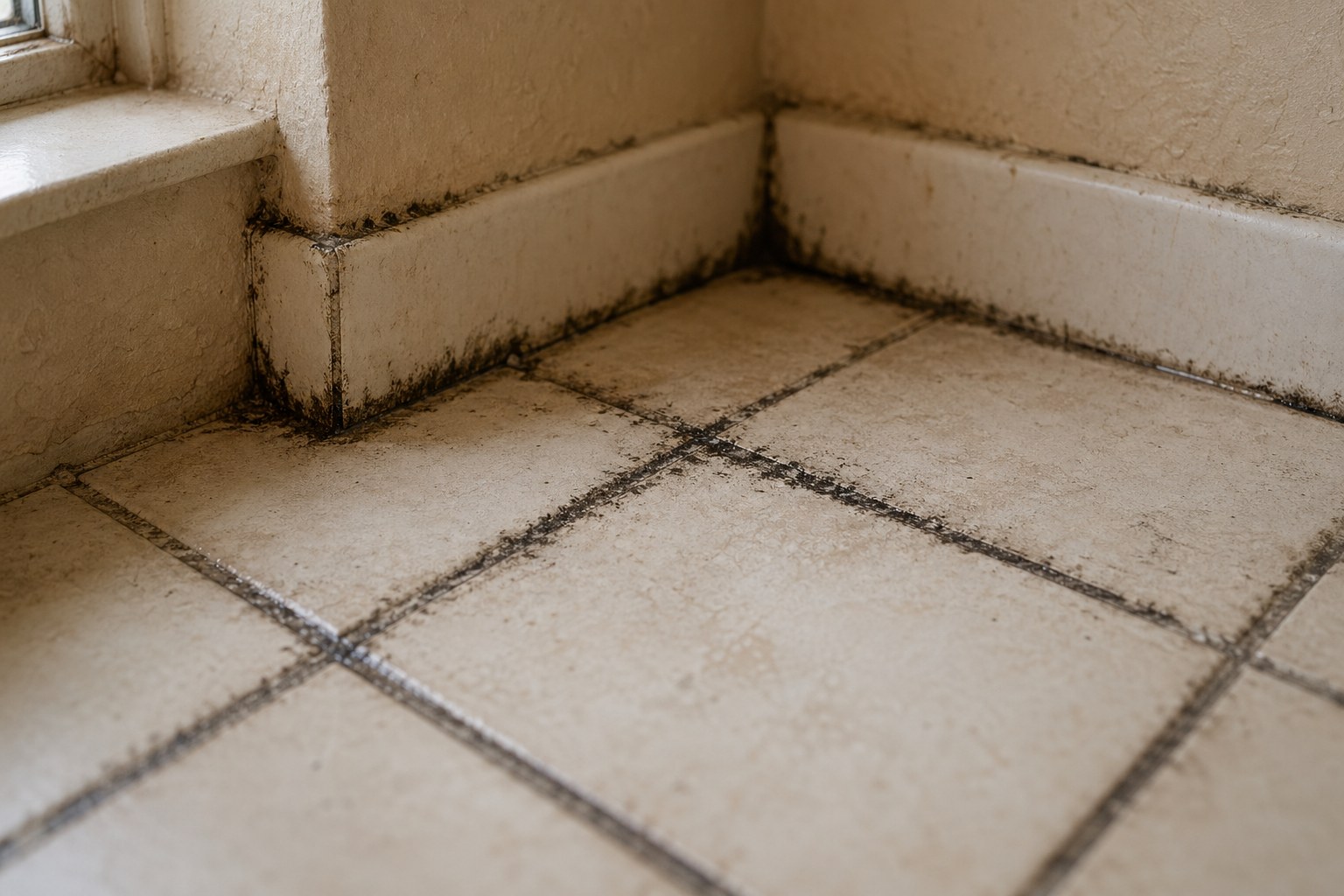
You found a fuzzy patch behind the laundry room door, and you have a jug of vinegar and a jug of bleach on the shelf above it. This guide on mold cleaning with vinegar — and when bleach is the right call instead — covers the surface you’re treating, the step-by-step that works, and the moment to bring in a contractor.
Mold spores germinate in roughly 24 hours after water exposure, with visible growth at 48–72 hours. Sarasota’s 77–86°F temperatures and 74% average relative humidity push every job to the fast end of that range.
Two facts shape every decision below. First, undiluted white vinegar (5% acetic acid) kills roughly 82% of mold species and penetrates porous surfaces. Second, the EPA’s published DIY ceiling is 10 square feet — anything bigger calls for a licensed remediation contractor.
Warning: Florida’s 24-hour mold germination window is real. If you had standing water from a leak, slab seepage, or hurricane intrusion in the last 48 hours, treat the area today — not next weekend.
Vinegar vs. Bleach: Which One for Which Surface
The single biggest reason DIY mold cleanups fail is the wrong product on the wrong surface. Bleach is roughly 90% water — on porous materials only the water absorbs, feeding the mold roots underneath while the bleach lifts the visible color. The EPA does not recommend bleach for routine mold cleanup on porous materials for exactly this reason. Vinegar’s 5–6% acetic acid penetrates the surface and reaches the roots.
| Surface | Vinegar | Bleach | Notes |
|---|---|---|---|
| Glazed ceramic tile (face) | Yes | Yes | Either works — bleach faster for stains |
| Tile grout | Yes | No | Grout is porous; bleach feeds re-growth |
| Glass / mirror | Yes | Yes | Either |
| Sealed concrete (slab, garage floor) | Yes | Yes | Common in Sarasota slab-on-grade homes |
| Unsealed concrete block / stucco | Yes | No | Most older Sarasota exterior walls |
| Painted drywall (light surface mold) | Yes | No | Bleach only bleaches the color |
| Bare drywall / behind drywall | Neither | Neither | Replace the section — call a pro |
| Finished hardwood (sealed) | Yes (light) | No | Light surface only |
| Bare wood framing / sub-floor | Neither | Neither | Pro remediation |
| Carpet / upholstery | Neither | Neither | Replace or pro-clean |
| Ceiling tiles (drop ceiling) | Neither | Neither | Replace |
| Bathroom caulk / silicone | Yes | Sometimes | If staining persists, replace caulk |
Most Sarasota homes built after 1970 are concrete block with stucco exterior, drywall interior, on a slab. The surfaces you’re most likely cleaning — interior painted drywall, grout, stucco patches, slab edges — call for vinegar, not bleach. Save the bleach for glazed shower tile, glass shower doors, and sealed garage floors.
Info: Porous surfaces take vinegar. Non-porous surfaces take either. Soft furnishings and structural materials call a pro.
Safety Gear and Setup Before You Start
Mold cleanup is not the time to free-style your PPE. Spore counts spike when you disturb a colony, and Florida homes run AC nine-plus months a year — whatever gets stirred up rides the duct system unless you turn the system off first.
For small jobs under 10 square feet:
- N95 respirator (fitted, not the loose dust mask)
- Nitrile gloves
- Safety glasses (sealed, not open-sided)
- Long sleeves you can wash hot or throw out
For post-hurricane work, larger jobs, or anyone with respiratory sensitivity:
- P100 respirator (99.97% filtration)
- Full sealed eye protection
- Disposable coveralls or long sleeves you will discard
Set up the room before you spray:
- Turn off central AC and seal supply/return vents in the room with plastic and tape
- Box fan in the window blowing OUT, not in
- Plastic sheeting on the floor under the work area
- Trash bag staged for contaminated rags and brushes
- Two clearly labeled spray bottles — one for vinegar, one for bleach, never reused between chemicals
Warning: Never mix bleach and vinegar — the reaction releases chlorine gas. If you use both products, finish one, rinse the surface with water, dry it, and wait at least an hour before applying the other. Same rule for bleach and ammonia, which produces chloramine vapors.
Step 1: Mold Removal with Vinegar — The Right Concentration and Dwell Time
Use vinegar undiluted. Period. A 50/50 vinegar-water mix is the single biggest reason home vinegar treatments fail. The acetic acid concentration is already only 5–6% out of the bottle; cutting it with water drops it below the threshold where it reliably kills mold.
Two vinegar choices: white distilled vinegar at 5% acetic acid runs $3–4 a gallon at any grocery store. “Cleaning vinegar” at 6% acetic acid sells at Home Depot and most hardware stores — about 20% stronger and worth the extra dollar for grout and stucco. Skip apple cider vinegar; the residual sugars feed re-growth.
The other half of failures come from rushing the dwell time. Vinegar needs a minimum of 60 minutes on the surface to penetrate and kill the colony. Spray, walk away, come back.
 Use cleaning vinegar undiluted — diluting it drops the acetic acid below the concentration needed to kill mold at the root.
The full process:
- Pour undiluted vinegar into a clean spray bottle. Do not add water, soap, or essential oils
- Spray the moldy area until it’s visibly saturated, covering a 1-inch margin around every visible spot
- Let it dwell 60 minutes minimum — leave the room
- Scrub with a stiff-bristle brush (grout brush for tile, soft brush for painted drywall)
- Wipe with a microfiber cloth and dispose of the cloth in your staged trash bag
- Optional baking-soda follow-up for stubborn staining: 1 teaspoon baking soda in 1 cup water, spray, scrub, wipe
- Rinse with clean water
- Dry thoroughly — point a fan at the area for at least an hour
- Inspect at 24 hours and again at 7 days
- Seal contaminated rags and brushes in a plastic bag and put it in the outdoor trash
Tip: Use vinegar undiluted. The bottle is already at the right concentration.
For exterior stucco, time the job for a low-humidity afternoon — usually right after a winter cold front. In July at 85% relative humidity, vinegar applied to stucco sits wet for hours and never properly dries.
Step 2: Mold Removal with Bleach — Non-Porous Surfaces Only
Before you open the bleach jug, confirm the surface is non-porous with the water-bead test. Drop a few drops of water on the surface. If they bead up and sit on top, the surface is non-porous and bleach is appropriate. If they soak in within seconds, switch to vinegar.
Standard household bleach is 5–6% sodium hypochlorite. Avoid “splash-less” or “low-splash” formulas — those are diluted to about 1–3% and won’t reliably kill mold. The working ratio is 1 cup of bleach per 1 gallon of cool water (hot water breaks down the active ingredient before you finish).
The process:
- Confirm the surface is non-porous with the water-bead test
- Pre-rinse with plain water to remove loose debris and dust
- Mix 1 cup bleach per gallon of cool water in a clean bucket
- Apply with a spray bottle on vertical surfaces, or a sponge mop on floors
- Let it dwell 10–15 minutes — extended contact damages many finishes
- Scrub with a stiff brush
- Rinse thoroughly with clean water and dry with towels plus a fan
Bleach cannot reach mold roots in porous materials. On grout, drywall, or wood, the chlorine bleaches the visible color while the mycelium underneath survives — and the colony returns within 2–4 weeks, often darker than before.
Warning: Bleach on porous surfaces (drywall, grout, wood, stucco) only removes the color. The mold returns. Switch to vinegar or call a contractor.
Step 3: Verify the Mold Is Actually Gone — Three-Tier Check
Verification is a three-tier process, and the real fix is the moisture source — not the surface treatment.
Tier 1 — Visual (immediate and at intervals):
- No visible discoloration or fuzzy texture on the treated surface
- No regrowth at 7 days
- No regrowth at 14 days
Tier 2 — Olfactory (24–48 hours after the area has fully dried):
- Put your nose 6 inches from the surface — no musty or earthy smell
- Run the test with the AC off and windows closed for 30 minutes first; HVAC airflow masks low-level mold odor
Tier 3 — Spore count (when you need certainty):
- DIY air-test kits run $30–60 at hardware stores
- Indoor-air-quality (IAQ) testers run $200–500 in Sarasota
- Compare indoor spore count to outdoor spore count taken the same day; indoor should not exceed outdoor
If the moisture source isn’t fixed — a slow leak, slab seepage, AC drain pan overflow, or hurricane window failure — the colony returns within 2–4 weeks regardless of how perfectly you cleaned the surface. Find the water before you trust the verification.
Tip: If indoor spore counts come back higher than outdoor counts, the mold is still there — usually inside the wall cavity where you can’t see it.
When to Stop DIY and Call a Sarasota Remediation Contractor
The EPA’s published DIY ceiling is 10 square feet — roughly a 3-foot by 3-foot patch. Past that threshold, the spore load during disturbance exceeds what a household respirator and a box fan can safely manage. Florida-specific triggers drop the threshold lower.
Stop DIY and call a contractor when:
- The affected area is larger than 10 square feet
- Mold appears on or behind drywall, sub-floor, or framing
- The growth followed hurricane flooding or standing water for 24+ hours
- You see mold inside the AC system, ducts, or air handler
- Anyone in the household has asthma, COPD, or immunosuppression
- The mold returns within 30 days of a successful-looking cleanup
- You can smell mold but cannot find the source
Sarasota cost ranges for 2025–2026:
- Inspection: ~$396 average
- Standard remediation: $1,222–$3,751
- Large jobs (post-hurricane, whole-home, HVAC contamination): $5,000–$15,000+
Professional remediation covers containment with plastic and zipper doors, HEPA air filtration during the work, drywall and insulation removal where the colony has penetrated, antimicrobial treatment of the framing behind it, and post-remediation clearance testing to confirm spore counts are back below outdoor levels.
Most Florida homeowner policies cap mold remediation coverage at $10,000 and require professional documentation to pay the claim. A licensed contractor’s scope-of-work, photo documentation, and post-remediation clearance test move an insurance claim from “denied” to “paid.”
Local restoration contractors handle assessments after hurricane or leak events and can coordinate insurance documentation with your carrier.
Info: Florida insurance reality — most policies cap mold coverage at $10,000 and require licensed-contractor documentation to pay the claim. DIY cleanup leaves no paper trail your adjuster can use.
Get a Sarasota Mold Inspection
In Sarasota humidity, every day of delay extends the mold’s reach further into your wall cavity, attic, or HVAC system. If the area is larger than 10 square feet, behind drywall, or following a hurricane or major leak, your next step is a professional assessment.
Describe the problem using the contact form on this site and we’ll try to connect you with a licensed Sarasota-area restoration contractor. We can’t guarantee a match. Ask any contractor whether they charge for an assessment before scheduling.
Common Mistakes That Make Mold Cleanup Fail
Most failed DIY mold jobs trace back to the same short list of mistakes. Read this list once before you start, and once again after you finish.
- Diluting the vinegar — a 1:1 vinegar-water mix cuts effectiveness below the kill threshold; use it straight from the bottle
- Spraying and wiping immediately — vinegar needs 60+ minutes, bleach needs 10–15; walk away and let chemistry happen
- Using bleach on grout, drywall, or wood — the roots survive, the color disappears, and the colony returns in 2–4 weeks
- Mixing bleach and vinegar — produces chlorine gas; pick one product, rinse the surface, dry it, then wait an hour before the other
- Painting over mold with “mold-killing” primer — primer over live mold buys 3–6 months at best before bleed-through
- Skipping the moisture fix — every cleanup is temporary if the leak, drain pan, or seepage source isn’t repaired
- Cleaning during peak humidity — at 85% RH the surface won’t dry; run AC and a dehumidifier first to drop the room below 50% RH
- Using apple cider vinegar — residual sugars feed re-growth; white or cleaning vinegar only
- Throwing contaminated rags in the laundry — bag them and toss; spores survive a wash cycle and contaminate the machine
- Treating only the visible spot — colonies extend 1–2 inches beyond what you can see; always work an inch of margin around every patch
Frequently Asked Questions
Does vinegar really kill mold?
Yes. Undiluted white vinegar (5% acetic acid) kills roughly 82% of mold species and penetrates porous surfaces — grout, drywall, stucco — where bleach cannot reach the roots. It does not kill every species and is not sufficient for areas larger than 10 square feet, which require professional remediation under EPA guidance.
Is bleach or vinegar better for mold?
It depends on the surface. Vinegar is better for porous materials (drywall, grout, wood) because it reaches mold roots. Bleach handles non-porous surfaces (glazed tile, glass, sealed concrete) for stain removal. The EPA does not recommend bleach for routine mold cleanup, since most household surfaces are at least partially porous.
How do I remove mold with vinegar from grout?
Spray undiluted cleaning vinegar (6%) onto grout lines until saturated. Let it dwell at least 60 minutes, scrub with a stiff grout brush, and wipe dry. For stubborn staining, follow with a baking-soda paste (1 teaspoon per cup of water), scrub, rinse with clean water, and dry thoroughly with a fan.
Is white vinegar mold removal safe around kids and pets?
Yes, once dried. Keep people and pets out of the room during application and drying — vinegar odor can irritate airways for an hour or two after spraying. Ventilate with a window fan blowing out and let surfaces dry completely before re-entry. Vinegar is non-toxic once evaporated, unlike bleach residue.
What’s mould cleaning vinegar? Is it different in the US?
Same product, British spelling. In US stores, look for “cleaning vinegar” (6% acetic acid) at Home Depot or Lowe’s, or “white distilled vinegar” (5%) at any grocery store. Either works undiluted; the 6% version is roughly 20% stronger and preferable for grout, stucco, and any deep-set staining.
How do I clean mold with bleach safely?
Mix 1 cup household bleach per 1 gallon of cool water. Apply only to non-porous surfaces (tile face, glass, sealed concrete). Let it sit 10–15 minutes, scrub, rinse thoroughly with clean water, and dry completely. Never mix with vinegar or ammonia. Wear an N95 respirator, nitrile gloves, and sealed safety goggles throughout.
Need a licensed Sarasota mold contractor? Describe the problem using the contact form on this site and we’ll try to connect you with a licensed Sarasota-area restoration contractor. We can’t guarantee a match.
Dealing with water damage in Sarasota?
Describe what happened and we'll try to connect you with a licensed Sarasota-area restoration contractor. We can't guarantee a match. Free to submit, no obligation.
Send Us Your Details