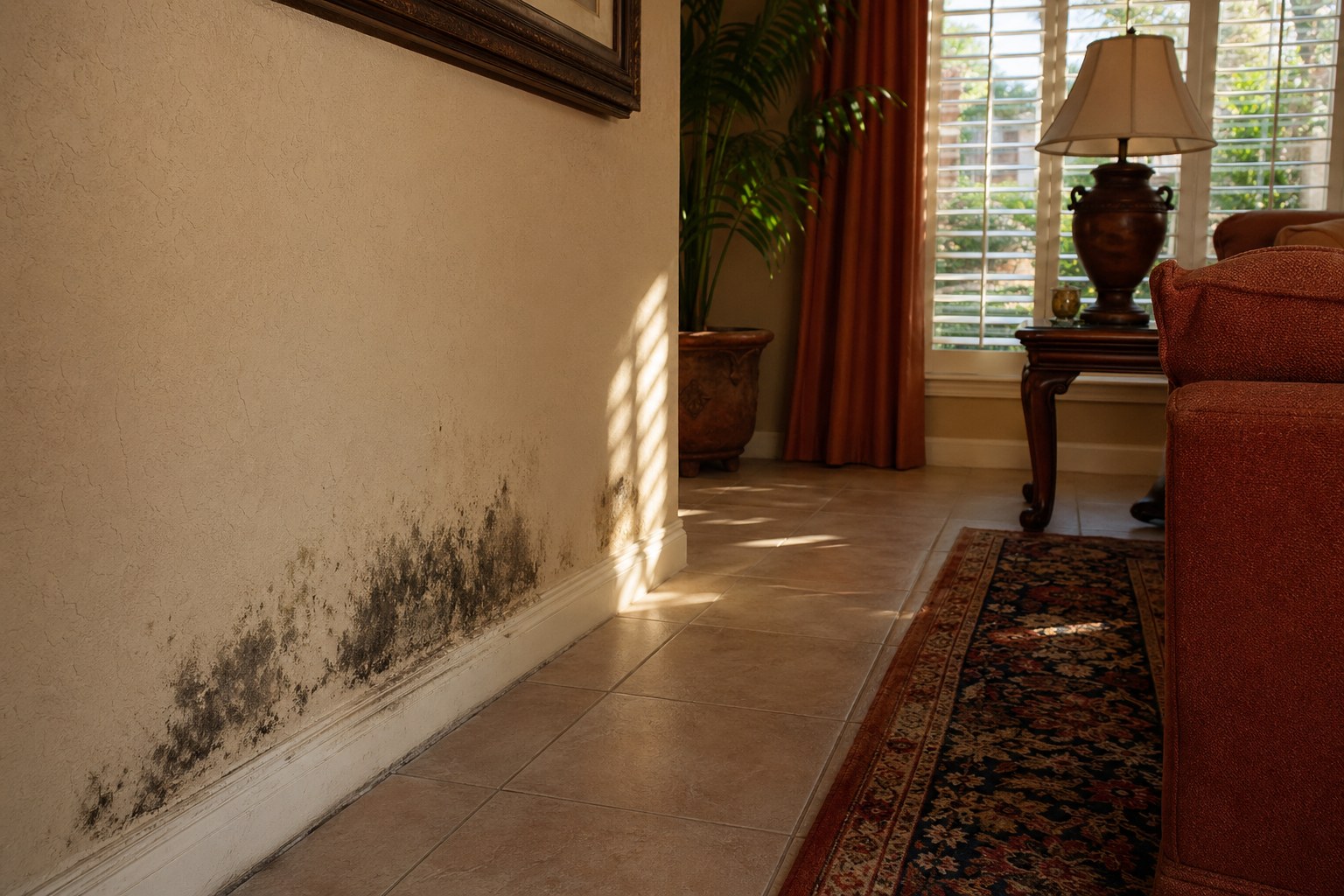
A fuzzy gray patch behind the couch or a black ring climbing the baseboard is a uniquely Sarasota stress. Ambient humidity here sits at 60-80% year-round, so the cavity behind your drywall is almost always wetter than the room. Learning how to remove mold from a wall in this climate is less about scrubbing and more about deciding which of two paths your wall is on.
Path A: a small surface stain on painted drywall, under 10 sq ft, with the moisture source already fixed. Clean, prime, repaint. Path B: drywall wet for 24+ hours, soft spots under thumb pressure, or affected area over 10 sq ft. Cut, replace, upgrade materials.
The single biggest mistake is reaching for bleach. Chlorine molecules are too large to penetrate drywall paper, and the water carrying them feeds the colony in the cavity. Use 3% hydrogen peroxide instead.
Eight steps follow, from finding the moisture source through filing your insurance claim. If you hit the triggers in Step 4, the job belongs with a licensed remediation contractor.
Warning: Do not use bleach on drywall. It cannot penetrate the paper face, and the water content feeds mold inside the cavity.
Step 1: Find and Stop the Moisture Source — Before You Touch the Mold
Cleaning a moldy wall without finding the moisture source guarantees a callback in two weeks. Mold spores are everywhere in Florida air; they only colonize a wall when something supplies continuous water. Until that supply is shut off, surface work is cosmetic.
Sarasota culprits, ranked by frequency: AC condensate clogs and air handler pan leaks (most common), hurricane-driven roof leaks, plumbing leaks behind kitchen and bathroom walls, slab seepage on ground-floor walls, post-flood saturation. Add window flashing failure for exterior walls — especially homes built before the 2002 Florida Building Code revisions.
Spend five minutes investigating before you touch anything. Feel the wall in a 3-foot radius for cool or damp spots. Look up for ceiling staining, down for swollen baseboard. Walk outside and check the stucco above the affected area for hairline cracks.
A moisture meter is worth the rental. Anything above 16% on drywall means active moisture. Home Depot rents pinless meters for around $40/day — well worth it before committing to either path.
Tip: If your AC runs constantly but the wall stays damp, the air handler pan or condensate line is leaking inside the cavity. Call an HVAC tech before a remediation contractor — fixing the source is upstream of the cleanup.
Step 2: Assess the Wall — Surface Stain or Cavity Mold?
In Florida, visible mold is usually only 20-30% of the actual colony. Drywall paper is cellulose — organic food. When the wall gets wet, mold colonizes the back face first because the cavity stays warmer and more humid than the room. By the time spotting shows up on your living room paint, the back of that drywall is worse than what you see.
Run four quick tests:
- Press the wall firmly with your thumb. Soft, spongy, or giving?
- Shine a flashlight at a raking angle. Bulges, waves, or rippling?
- Pull an outlet cover and smell the cavity. Musty or basement-like?
- Measure the visible patch. Larger than a sheet of letter paper (~0.6 sq ft)?
Decision rule: if any one test comes back yes, OR the wall was wet for 24+ hours, OR the affected area exceeds 10 sq ft — Path B (remove and replace). If all four pass, the moisture source is fixed, and the patch is small surface stain on painted drywall — Path A (clean).
The IICRC S520 standard (2024, 4th edition) does not set a hard DIY-vs-pro line at 10 sq ft — that’s older EPA guidance still floating around. S520 sets containment requirements: limited containment for 10-100 sq ft, full negative-pressure containment over 100.
After a tropical storm, walls saturated by storm surge or wind-driven rain are almost always Path B even when they look dry. Florida humidity prevents drywall from drying inside-out — the surface dries first while the cavity stays wet for weeks.
Warning: If your wall was wet for more than 24-48 hours, assume cavity mold even if the surface looks clean.
Step 3: PPE — What to Wear Before You Touch Anything
The right PPE costs about $35 and takes five minutes to put on. The wrong call — a cloth mask, bare hands, open-sided sunglasses — turns a Saturday job into an urgent-care visit.
Gear list:
- N95 respirator minimum. P100 half-face cartridge respirator is better, ~$30, reusable.
- Nitrile gloves, 6-mil heavy-duty (not the thin food-prep kind)
- Sealed safety goggles, not open-sided glasses
- Long sleeves and pants you’ll throw away
- Disposable shoe covers
Cloth and surgical masks filter essentially nothing here. Mold spores are 2-10 microns and pass through fabric weave. N95 is the floor.
Containment matters even for small jobs. Tape 6-mil plastic over the doorway. Run a box fan in a window blowing OUT for negative pressure. Turn off the central HVAC for the duration of the work.
When done, double-bag everything — rags, gloves, drywall scraps — in 6-mil contractor bags, tape shut, walk straight to the curb. Don’t let those bags sit in your garage overnight.
Tip: Turn off your central HVAC before disturbing any mold. Sarasota homes recirculate cabin air every ~4 minutes — one cleaning session can push spores through every duct.
Step 4: DIY or Pro — How to Know Before You Start
Most Sarasota mold jobs are genuinely DIY-able — but five situations make calling a contractor the smarter move. Doing it wrong creates a bigger problem than the mold itself.
Call a pro if any of these are true:
- Affected area larger than 10 sq ft
- Mold extends inside the cavity (you got “yes” on the soft-drywall test)
- Moisture source was sewage, storm surge, or unknown standing water — Category 3 under IICRC S500
- Anyone in the home is immunocompromised, asthmatic, pregnant, or under 5
- You plan to file an insurance claim — pros generate the IICRC S520 documentation insurers require, and that paperwork is the difference between a paid and denied claim
Sixth situation for repeat offenders: if you cleaned the wall once and mold returned within months, the cavity is the source. Surface cleaning will never fix it.
Sarasota-specific timing: contractor demand spikes 4-6 weeks after a named storm. Get on a remediation schedule the same week — by week three you’re looking at a month-out wait.
Steps 5 and 6 split the path. Step 5 is Path A (cleaning surface mold). Step 6 is Path B (cutting and replacing drywall). Skip the one that doesn’t apply.
Tip: If mold came back after one cleaning, stop cleaning. The cavity is the source.
If any of those five situations describe yours, the job belongs with a licensed remediation contractor who works to IICRC S520 and can generate the insurance-grade documentation needed for Step 8. Describe the problem using the contact form on this site and we’ll try to connect you with a licensed Sarasota-area restoration contractor. We can’t guarantee a match.
Step 5 (Path A): How to Clean Surface Mold from a Painted Wall
Use this path only for painted-drywall surface stains under 10 sq ft, with confirmed-fixed moisture and no soft spots. If unsure after Step 2, default to Path B. The discipline is in the products.
Tool list:
- Spray bottle
- Microfiber cloths (not sponges — sponges trap and spread spores)
- Soft-bristle brush
- 3% hydrogen peroxide from any drugstore (
$3) OR Concrobium Mold Control ($15, EPA-registered borate cleaner)
Procedure:
- Lightly mist the area with hydrogen peroxide. Don’t soak.
- Let it dwell 10 minutes. Oxidation needs contact time.
- Agitate with a soft brush in one direction only. Back-and-forth scrubbing aerosolizes spores.
- Wipe with a damp microfiber, then a dry one.
- Bag both cloths immediately and take them to the curb.
Hydrogen peroxide oxidizes the spore cell wall and breaks down into water and oxygen — zero residue, zero chlorine salts. Bleach can’t penetrate drywall paper, and its water feeds anything the surface didn’t kill. Vinegar kills ~82% of mold species but leaves an acetate residue that can feed regrowth; acceptable as a pre-treatment, never as the only cleaner.
Dried mold spores aren’t dead, they’re dormant. Any future moisture event reactivates them. That’s why drying (Step 7) and priming (Step 8) matter as much as cleaning.
Do not paint for at least 48 hours, and not before Step 7. Painting over a wall that still holds moisture seals water inside the cavity and guarantees recurrence.
Warning: Skip bleach on drywall. Use 3% hydrogen peroxide instead.
Step 6 (Path B): Cut Out and Replace Mold-Damaged Drywall
Cut back at least 12 inches beyond the visible edge in all directions. Cavity colonies routinely extend that far without surface evidence. Cut conservatively and you’ll be cutting again in a month.
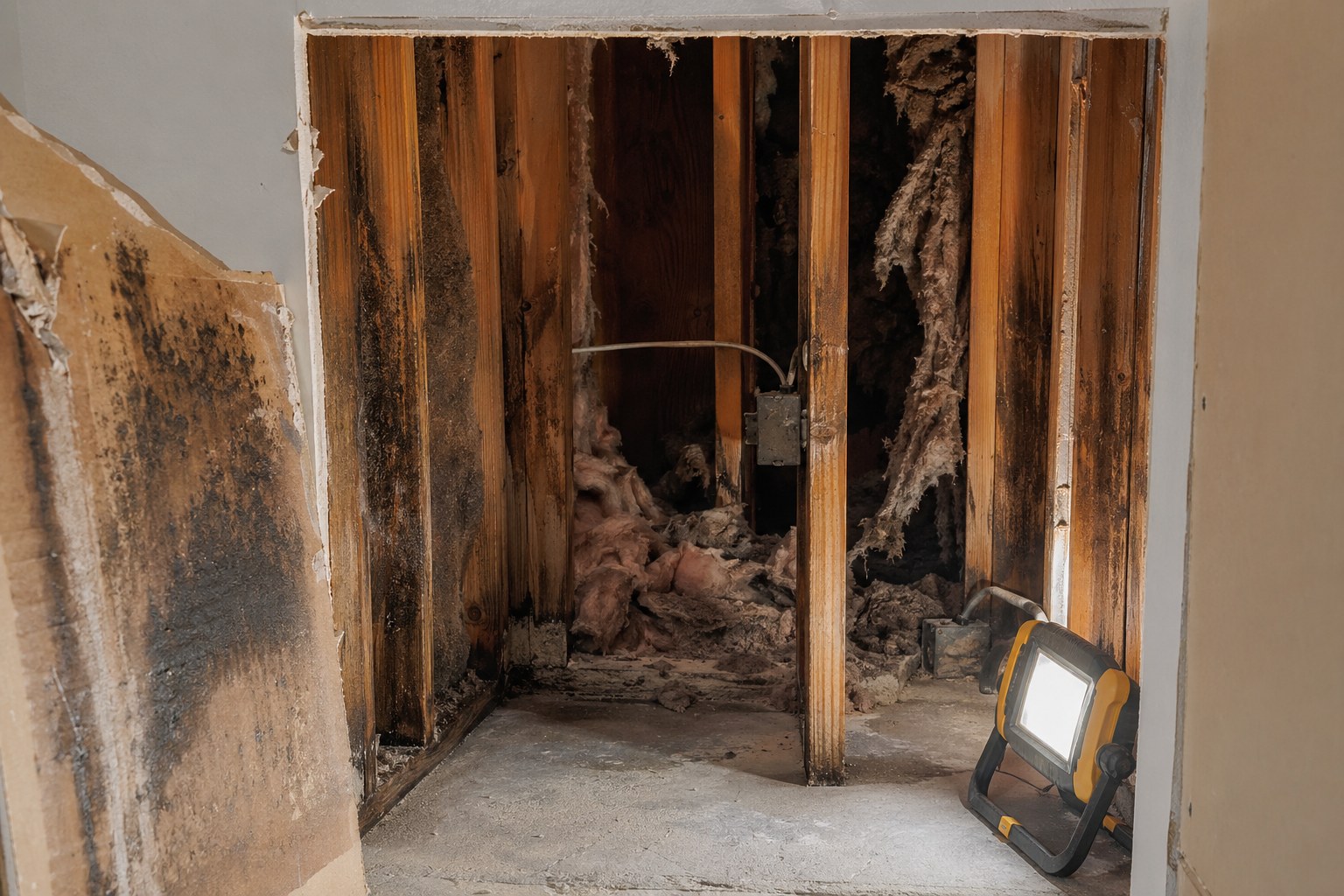 Inside a Sarasota home wall cavity after drywall removal: mold has colonized the framing well beyond the visible surface patch.
Cutting procedure:
- Score the perimeter with a utility knife first. No Sawzall — drywall dust is the spore vehicle.
- Use an oscillating multi-tool or hand drywall saw with a HEPA vacuum running at the cut line.
- Bag pieces immediately as they come out. Don’t stack on the floor.
Inside the open cavity, pull all wet insulation. Pink fiberglass holds water like a sponge — it cannot be dried and reused. Inspect studs and bottom plate. Surface mold on framing? Wire-brush and treat with borate. If the wood is structurally compromised — soft, dark, fibrous under a screwdriver — stop and bring in a contractor.
Before you close the wall, dry the cavity properly. Run a dehumidifier (not a fan) pointed into the open cavity for 48-72 hours. Target framing moisture below 15% on your meter before new drywall goes up.
When you replace, do not put back standard paper-faced drywall. Use DensArmor Plus or ToughRock Mold-Guard — fiberglass-faced boards that eliminate the organic food source. They run $4-$6 more per sheet and are the single best Sarasota upgrade for a wall you’ve already opened.
Stop and call a remediation contractor if mold extends to more than two studs, the back of the bottom plate, or affected area exceeds 32 sq ft. That’s IICRC S520 Level 2 or 3 containment territory.
Sarasota note: Florida Building Code requires a permit for drywall replacement over 32 sq ft in many county jurisdictions, and post-storm replacements often have stricter inspection requirements. Check before you cut.
Warning: Wet fiberglass insulation cannot be dried and reused. Replace it.
Step 7: Dry the Wall the Right Way — No Open Windows in Sarasota
Opening the windows to dry a wall in Sarasota makes it wetter. Northern guides say “ventilate the area.” That’s correct in Denver and actively harmful here, where outdoor air sits at 70-80% RH most of the year — wetter than the inside of your closed house.
 Closed-room dehumidification with a fan draws moisture away from the wall surface — opening windows in Sarasota’s 70-80% outdoor humidity makes walls wetter, not drier.
Run a dedicated dehumidifier 48-72 hours minimum after cleaning or replacing drywall. Target indoor RH between 40-50%. A standard 50-70-pint consumer unit covers 1,000-2,000 sq ft — fine for a single bedroom or living area.
Placement: dehumidifier in the same room, door closed, small fan moving air across the wall surface. The dehumidifier removes vapor; the fan keeps moist air from stagnating against the wall.
Verify with a moisture meter before calling the wall dry. Targets: drywall under 12%, framing under 15%.
Dormant spores wake up at 60% RH and above. A wall dried to “looks fine” inside a house running at 65% RH will grow mold again within weeks. The structural fix is long-term humidity control — a whole-house dehumidifier, or running your AC often enough to dehumidify properly. Oversized AC units short-cycle, cooling without removing moisture, and Sarasota will remind you within a season.
Warning: Do not open windows to dry a Sarasota wall. Outdoor air averages 70-80% RH.
Step 8: Prime, Repaint, and Document for Your Insurance Claim
About 35% of denied mold claims in Florida cite insufficient documentation. Most Florida policies cap mold coverage at $1,000-$10,000, and adjusters require photos at every stage. The closeout is where the actual money is on the table.
Prime first, even on Path A. Use Zinsser Mold Killing Primer — EPA-registered fungicidal coating, ~$20/quart, 30-minute dry time. It blocks stains and prevents recurrence. Flat wall paint over a previously moldy wall is a reset clock, not a fix.
Topcoat: bathroom or kitchen-grade paint with mildewcide built in. Sherwin-Williams Duration, Behr Premium Plus Ultra, and Benjamin Moore Aura Bath & Spa all qualify. Two coats. Standard flat wall paint fails in Sarasota humidity within 18-24 months regardless of what’s underneath.
Insurance documentation checklist — assemble as you go:
- Photos of original damage with a ruler in frame for scale
- Photos of the moisture source you identified and how you fixed it
- All receipts: PPE, cleaning materials, dehumidifier rental, contractor invoices
- Moisture meter readings, logged with date and time
- Photos of the cleaned or replaced area, including new primer and paint
- Written timeline from original water event to current date
Florida filing reality: Citizens, Universal, and most major Florida carriers require notice of loss within 14 days under post-2022 reform rules. File when you discover the mold, not when the work is done. Update the claim with completed-work documentation later — late notice is the second most common reason mold claims get denied.
Tip: File your Florida insurance notice of loss within 14 days of discovering the mold — even before work begins.
If you hired a remediation contractor, ask for the IICRC S520 post-remediation verification document. That single piece of paperwork satisfies most adjusters’ documentation requirements on its own.
Frequently Asked Questions
Can I just paint over mold on a wall?
No. Paint does not kill mold — the colony grows under the new layer and bleeds back through within weeks. Clean with hydrogen peroxide, dry the wall completely, and prime with a fungicidal primer like Zinsser Mold Killing Primer before any topcoat.
Does bleach kill mold on drywall?
Not effectively. The chlorine molecule is too large to penetrate drywall’s paper face, so it only treats the surface. The water bleach is mixed with soaks into the cavity and feeds any subsurface colony. Use 3% hydrogen peroxide instead — it oxidizes the spore wall and leaves no residue.
Does vinegar kill mold on walls?
Partially. White vinegar kills about 82% of common mold species but leaves an acetate residue that can feed regrowth. Acceptable as a pre-treatment, not as the only cleaner. Follow vinegar with hydrogen peroxide for a complete kill.
How much does mold removal cost in Sarasota?
DIY for a small surface job: $50-$100 in materials. Professional remediation in Sarasota: typically $1,500-$6,000 for under 100 sq ft, $10,000+ for whole-room or post-storm work. Cost depends on containment level, demolition scope, and whether HVAC cleaning is required.
How do I know if it’s black mold?
You can’t reliably identify a species by sight — many dark molds resemble Stachybotrys. Treatment is the same regardless of color. If species ID matters for a health concern or insurance claim, hire an independent mold assessor (separate from the remediation contractor) for a $300-$600 air-quality test.
How long does mold take to grow back in Florida?
Aspergillus, Penicillium, and Cladosporium can colonize a wet surface in 24-72 hours. Stachybotrys (black mold) needs 7+ days of continuous moisture. In Sarasota’s 60-80% humidity, dormant spores reactivate quickly — which is why drying and priming matter as much as cleaning.
Will my Florida homeowners insurance cover mold removal?
Sometimes. Most Florida policies cover mold only when caused by a separately covered peril (sudden plumbing burst, hurricane-driven roof leak), and most cap mold coverage at $1,000-$10,000. Long-term leaks, maintenance issues, and gradual seepage are excluded. File notice of loss within 14 days regardless.
Should I get an air quality test before or after mold remediation?
Both, ideally. A pre-test confirms an indoor mold problem versus normal outdoor counts. A post-test verifies the cleanup worked. If you can only afford one, do the post-test — it’s the document insurance adjusters and future buyers care about. Use an assessor who is not the remediation contractor.
Mold on a Sarasota wall almost always points to a deeper moisture story, and the right move depends on how far the colony has spread inside the cavity. If you worked through Step 2 and the wall failed any of the four tests, or you’re staring at a job larger than you want to handle on a Saturday, a licensed remediation contractor can scope it, document it for your carrier, and replace the drywall with the mold-resistant materials that should have been there in the first place. Describe the problem using the contact form on this site and we’ll try to connect you with a licensed Sarasota-area restoration contractor. We can’t guarantee a match.
Dealing with water damage in Sarasota?
Describe what happened and we'll try to connect you with a licensed Sarasota-area restoration contractor. We can't guarantee a match. Free to submit, no obligation.
Send Us Your Details