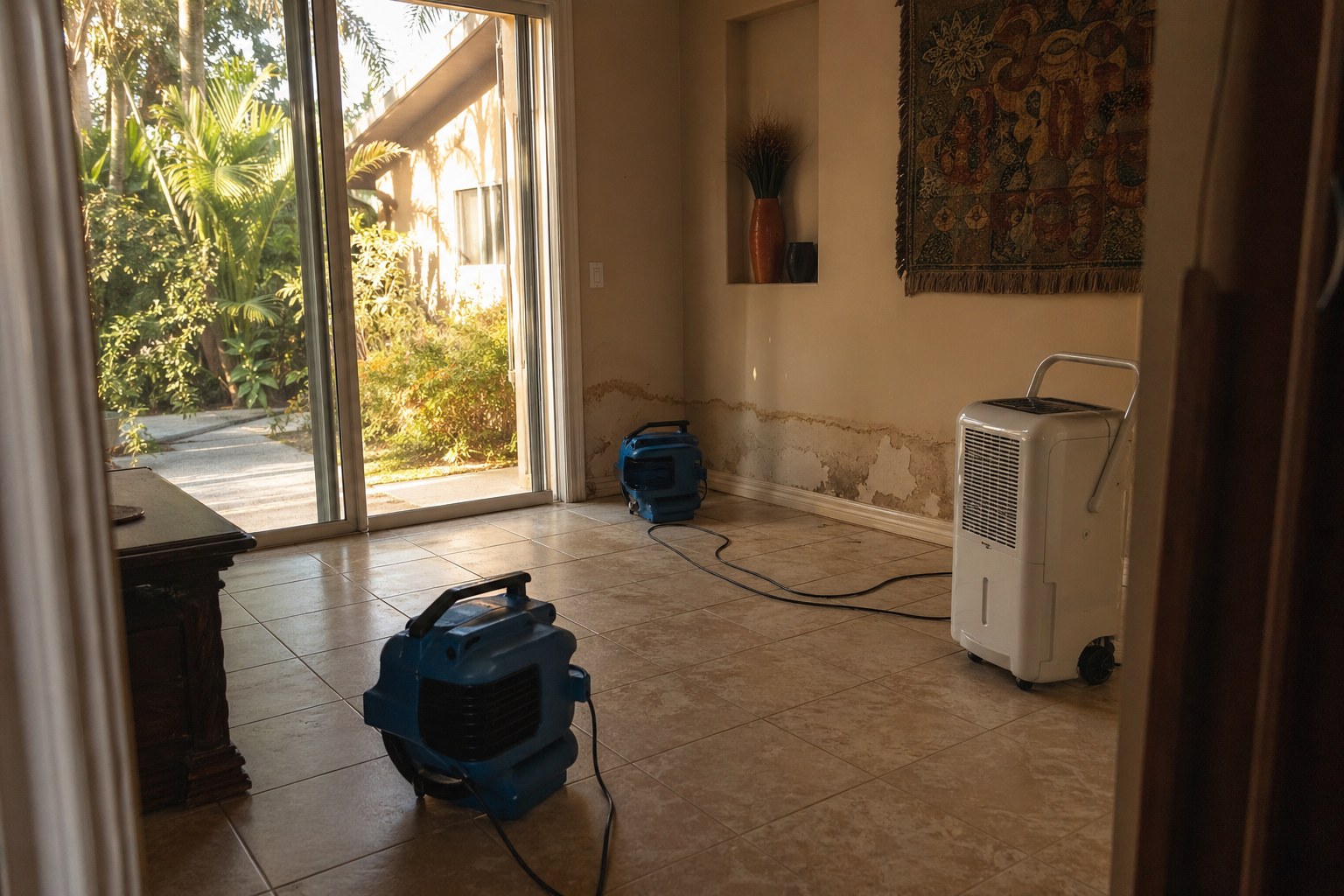
Outdoor humidity in Sarasota sits between 72 and 78 percent year-round, and after a thunderstorm or tropical event, indoor relative humidity can climb past 70 percent within hours. The honest answer on dehumidifiers and mold: a dehumidifier does not kill mold, but the right unit in the right conditions stops mold before it starts and stalls existing growth. Florida’s climate, combined with snowbird vacancy patterns from May through October, turns small dehumidifier mistakes into $15,000–$25,000 mold claims. If you are standing in a wet house right now, jump to the post-flood section.
The Truth About Dehumidifiers and Mold (They Don’t Kill It)
No, a dehumidifier does not kill mold — it reduces humidity, and reduced humidity is what stalls mold growth. A dehumidifier pulls humid air across cold coils, condenses moisture into water, drains it into a tank or hose, and returns drier air to the room. That is the entire mechanism.
The CDC recommends keeping indoor relative humidity below 50 percent. The EPA notes that above 60 percent, mold growth is likely. At roughly 45 percent RH, active mold growth halts and existing colonies become dormant — drying into brittle patches that are easier to remove.
Dormant is not dead. Mold spores survive for years in a dry state and reactivate the moment humidity climbs back above 60 percent. A dehumidifier is a humidity tool, not a remediation tool. Used correctly, it prevents the conditions mold needs. Used after visible mold has taken hold, it buys time but does not solve the problem.
Tip: EPA: above 60% RH, mold growth is likely. CDC recommends keeping indoor humidity below 50%.
How Mold Grows in Sarasota Homes (And Why You’re Fighting Uphill)
A wet bath towel left on the floor for two days does nothing in Phoenix; in Sarasota, that towel grows mold by Sunday. Outdoor RH here averages 72 to 78 percent, and indoor RH tracks within 10 to 15 points of outdoor without active dehumidification. After any water intrusion, mold colonizes drywall, carpet pad, insulation, baseboards, and wood framing within 24 to 48 hours. Visible colonies appear in 18 to 21 days, and Sarasota’s heat runs that clock faster than IICRC (Institute of Inspection, Cleaning and Restoration Certification) averages.
Three mold species dominate Florida homes:
- Cladosporium — olive-green, found on HVAC components, window sills, and damp drywall. Primary indoor allergen.
- Aspergillus — yellow-green to gray, colonizes drywall and upholstery. Some strains produce mycotoxins.
- Stachybotrys chartarum (black mold) — needs cellulose-based materials wet for 7+ days, releases mycotoxins linked to respiratory harm, and is the species most cited in serious post-flood claims.
 Cladosporium and Stachybotrys are the mold species most commonly found in Sarasota homes after flooding — and both begin colonizing within 48 hours.
After Hurricane Ian and Hurricane Helene, restoration crews documented all three species inside affected homes within a week of the storms. The question in Sarasota is never if indoor humidity hits mold-friendly levels — it is when.
Warning: Mold can begin growing within 24–48 hours after water damage. In Sarasota’s climate, that clock runs fast.
When a Dehumidifier IS the Right Tool
Three Sarasota scenarios where a dehumidifier is the correct first move:
1. Year-round prevention in occupied homes. AC alone does not dehumidify well on cool Sarasota days — the system short-cycles, satisfying the thermostat before pulling meaningful moisture out of the air. A 30 to 50 pint consumer unit ($150–$350) placed in laundry rooms, primary closets, lanai pass-throughs, or storage rooms holds RH between 45 and 50 percent.
2. The first 24 hours after water intrusion. Burst supply line, slow dishwasher leak, roof drip during a storm — catch it quickly, close off the wet zone, run a dehumidifier on maximum alongside your AC and a few air movers. This is the window where DIY drying actually works.
3. Snowbird vacancy. Roughly half of Sarasota’s housing stock sits empty May through October. Without active humidity control, indoor RH climbs past 75 percent within a week of leaving. A dehumidifier plumbed to a drain line, paired with the AC running at 78 degrees, is the most reliable vacancy protection short of a whole-home system.
When a Dehumidifier Is NOT Enough
Most homeowners who Google “dehumidifier and mold” already have a problem a dehumidifier cannot fix. Three situations where a Home Depot purchase wastes time:
1. You can already see mold. Visible colonies — green, black, or white fuzz on drywall, baseboards, ceiling tiles, or behind furniture — mean airborne spore counts are elevated. EPA guidance states that visible mold covering more than 10 square feet requires professional remediation. A dehumidifier slows expansion but cannot remove existing colonies or decontaminate building materials.
2. Water has been sitting more than 48 hours. Moisture has wicked into wall cavities, subfloor, insulation, and framing. Consumer dehumidifiers cannot pull water through saturated drywall — they only address ambient room air. Restoration crews use cavity injection systems, commercial low-grain refrigerant dehumidifiers, and targeted air movers to dry inside wall and floor assemblies.
3. Musty smell with no visible source. That earthy odor is mVOCs — microbial volatile organic compounds released by active mold growth. Smelling it without seeing it almost always means hidden colonies inside the HVAC system, behind walls, or under flooring.
Visible mold, standing water, or a musty smell with no clear source? Describe the problem using the contact form on this site and we’ll try to connect you with a licensed Sarasota-area restoration contractor. We can’t guarantee a match.
How to Size a Dehumidifier (Consumer vs. LGR vs. Whole-Home)
Manufacturer pint ratings are tested at 80 degrees and 60 percent RH, which is why a “50 pint” consumer unit pulls 25 to 35 pints in real Sarasota conditions. Real-world extraction runs 30 to 50 percent below the box number. Buy 30 to 50 percent larger than you think you need.
| Type | Best Use | Capacity | Price |
|---|---|---|---|
| Consumer (30–50 pt) | Prevention, vacancy | 500–1,500 sq ft | $150–$350 |
| LGR commercial (70+ pt) | Flood recovery | 1 per 1,000 sq ft (IICRC S500) | $800–$2,500 (or rent $80–$150/day) |
| Whole-home (HVAC-integrated) | Year-round Sarasota control | Whole house | $1,500–$3,000 installed |
Consumer units. Plumb to a floor drain or condensate pump — tanks fill in 4 to 8 hours in Sarasota humidity, and a full tank shuts the unit off. Never rely on the reservoir for unattended operation.
LGR commercial units. Low-grain refrigerant dehumidifiers continue extracting moisture at low RH where consumer units shut off. The IICRC S500 restoration standard calls for one LGR unit per 1,000 square feet during flood recovery. A 2,500 square foot flooded house needs 2 to 3 units running continuously for 4 to 7 days. Renting at $80 to $150 per unit per day is usually cheaper than buying for a single event.
Whole-home dehumidifiers. Aprilaire E100, Honeywell DR90, and Santa Fe Ultra are the common options. They tie into your HVAC return ducting, run on a humidistat, and eliminate the AC short-cycling problem entirely. For a Sarasota home occupied year-round, this is the lowest-maintenance long-term solution.
How to Run a Dehumidifier After a Flood (The First 72 Hours)
Placing a dehumidifier in a wet room and walking away is how most DIY flood drying jobs fail. Three operational points separate working drying from useless drying:
1. Containment and air movement come first. Close off the wet zone with plastic sheeting or closed doors — otherwise you are trying to dehumidify the entire house. Add air movers (centrifugal fans) positioned 16 inches off the floor, angled at 45 degrees across wet surfaces. Air movement converts surface moisture into vapor; the dehumidifier removes the vapor. One without the other does not work.
2. Placement and settings. Center of the affected room, at least 12 inches from any wall, intake unobstructed. Set to continuous operation — not humidistat-controlled — for the first 72 hours. Plumb to a drain instead of relying on the tank. Buy a $15 hygrometer and place it across the room from the unit; the goal is moving from 90+ percent RH down to under 50 percent within 48 hours.
3. Monitor, document, and stop at the right number. A pinless moisture meter ($40–$80) is non-negotiable. Log readings on drywall, framing, and subfloor daily, with date, time, and location. Drying is complete when wood framing reads under 16 percent moisture content and drywall reads 8 to 10 percent. That log is also your insurance documentation — adjusters routinely deny claims when homeowners cannot prove materials reached dry standard.
If readings are not dropping by day three, stop and call a professional. Hidden water is winning, and another 48 hours of running a consumer unit will not change the outcome.
Tip: Log daily moisture-meter readings with date, time, and location — insurance adjusters routinely deny claims without documented drying proof.
The Dehumidifier Mold Trap (Yes, the Unit Itself Grows It)
A dehumidifier pulls warm humid air across cold wet coils into a standing-water tank — that is an ideal mold habitat inside the appliance you bought to prevent mold.
1. Where mold grows inside the unit. The collection tank holds standing water mixed with organic dust pulled from your air. The coils and condensate pan stay dark and wet. The intake filter stays warm, damp, and loaded with the spores it just captured. After two weeks without maintenance, an unmaintained dehumidifier can release more spores into your home than it removes.
2. Two-week maintenance rhythm. Every 14 days: empty the tank, wipe the interior with a 1:10 bleach-to-water solution or undiluted white vinegar, let it air-dry completely before reassembling. Pull the filter, rinse it, air-dry it. Once per season: vacuum the coils with a soft brush attachment and wipe down the condensate pan.
3. Signs the unit has turned. A musty smell when it kicks on. Visible slime in the tank. Black or green spots on the coils. Stop using it indoors until cleaned, and replace the unit if the coils are pitted or stained beyond cleaning.
Warning: Clean the tank, filter, and coils every 14 days. An uncleaned dehumidifier can spread more spores than it removes.
Protecting a Vacant Sarasota Home (The Snowbird Playbook)
The single most expensive mold mistake in Sarasota is turning the AC off when leaving for the summer — restoration crews see $15,000 to $25,000 mold claims every season from homes left with the thermostat off or set to 85 degrees.
Why vacancy is mold’s perfect setup. Without AC running enough to dehumidify, no one notices a slow supply-line drip, a roof leak after an afternoon storm, or a failed water heater. Indoor RH climbs past 75 percent within a week of departure. By mid-July, closets, leather goods, drywall behind furniture, and the underside of mattresses show visible colonies.
Minimum vacancy protocol. Set the AC to 78 degrees — never off. Add a 50-pint consumer unit plumbed to a drain, or install a whole-home dehumidifier on the HVAC return. Set the humidistat to 50 percent. Combined AC and dehumidifier electricity costs $40 to $80 per month. The alternative is a $15,000 to $25,000 remediation invoice and weeks of demolition when you return.
 A dehumidifier plumbed to a drain line is the most reliable vacancy protection for a Sarasota home left empty for the summer.
Home-watch overlay. Schedule a weekly walk-through with a local home-watch service or a trusted neighbor. Install a remote-monitoring hygrometer ($30 on Amazon) that sends humidity alerts to your phone. Have the watcher confirm the AC is running, check for ceiling stains, and look at the dehumidifier’s drain line.
Tip: Set thermostat to 78°F minimum — never turn the AC fully off. The monthly electricity savings are not worth a $15,000 mold remediation.
Frequently Asked Questions
Does a dehumidifier kill mold?
No. A dehumidifier reduces humidity, which stalls active mold growth at around 45 percent RH and prevents new growth below 50 percent. Existing colonies become dormant, not dead — spores survive for years and reactivate when humidity climbs back above 60 percent. Killing mold requires physical removal or remediation.
What humidity level stops mold from growing?
Below 50 percent relative humidity halts active mold growth, per CDC guidance. The EPA notes that above 60 percent, mold growth becomes likely. The practical Sarasota target is 45 to 50 percent indoor RH year-round, measured with an inexpensive hygrometer placed away from AC vents and exterior doors.
Will a dehumidifier help with mold I can already see?
Not meaningfully. Visible mold means colonies are established and spore counts are elevated. A dehumidifier slows expansion but cannot remove growth. EPA guidance requires professional remediation for visible mold over 10 square feet. For smaller patches, physical removal followed by humidity control is the correct sequence.
How long should I run a dehumidifier after a flood?
Run continuously — not on a humidistat — for the first 72 hours, paired with air movers and AC. Continue until wood framing reads under 16 percent moisture content and drywall reads 8 to 10 percent on a pinless moisture meter. Most Sarasota flood-recovery jobs need 4 to 7 days of LGR commercial drying.
What size dehumidifier do I need for a Florida home?
For prevention in occupied rooms, a 30 to 50 pint consumer unit covers 500 to 1,500 square feet. For flood recovery, IICRC S500 calls for one LGR commercial unit per 1,000 square feet. Buy 30 to 50 percent larger than rated capacity, since real-world extraction runs well below the box number.
Can a dehumidifier itself grow mold?
Yes. The collection tank, coils, condensate pan, and air filter hold standing water and trapped spores — ideal mold habitat. An unmaintained unit can release more spores than it removes after about two weeks. Empty and disinfect the tank, rinse the filter every 14 days, and vacuum coils once per season.
Dealing with water damage or a mold problem in your Sarasota home? Describe the problem using the contact form on this site and we’ll try to connect you with a licensed Sarasota-area restoration contractor. We can’t guarantee a match.
Dealing with water damage in Sarasota?
Describe what happened and we'll try to connect you with a licensed Sarasota-area restoration contractor. We can't guarantee a match. Free to submit, no obligation.
Send Us Your Details